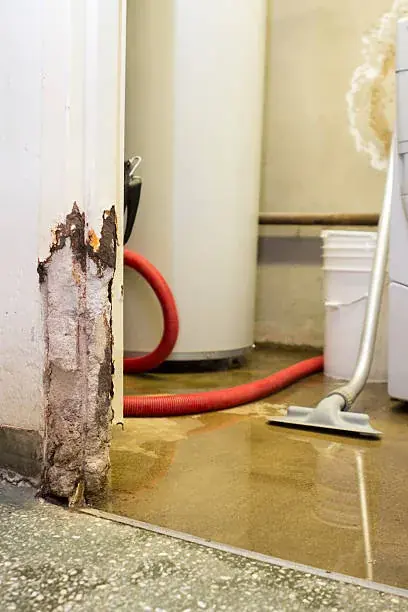
A failing water heater rarely gives much warning. In North Hollywood crews see it most in pre-1980 slab homes and dense apartments where the tank sits in a garage or a narrow hallway closet, so the moment a seam lets go the water runs straight under the drywall and toward the next room. On a hot Valley day the heater is already working overtime, and a corroded tank picks that moment to give out. The faster the tank is isolated and the standing water is pulled, the smaller the repair and the fewer materials you replace.
Stop the source, then get the water out
When you call, the first job is control. Crews close the cold-water supply at the tank and cut the gas or power, then start extraction so the water stops migrating into wall bases and subfloor.
- Shut the supply valve and isolate the gas control or breaker.
- Truck-mount and portable extraction of standing water from the closet or garage slab.
- Pull baseboard and drill weep holes so trapped water in the wall cavity can drain.
- Move and protect stored boxes, tools, and appliances sitting in the flood path.
- Lift and dry any wet flooring or matting before it traps moisture against the slab.
- Meter adjoining rooms so a hidden path under the threshold does not get missed.
Dry the structure before it spreads
Water from a tank wicks into bottom plates, drywall, and any shared wall with the kitchen or a bedroom, and it keeps moving long after the floor looks dry. Crews set drying equipment and monitor it daily against IICRC standards so the closet and neighboring framing come back to a dry, verified reading rather than a guess.
- Air movers and low-grain dehumidifiers sized to the room and the wet materials.
- Daily moisture logs on the closet, the shared wall, and the floor next door.
- Use the drying-time estimator for a realistic timeline.
- Coordinate any needed structural drying and dehumidification for larger spreads.
Signs your tank is about to go
Most failures give quiet hints for weeks before the seam finally opens. Catching them early keeps a small drip from becoming a garage flood, and a quick shutoff on the first sign of trouble saves the drywall next door. The CPSC also notes that aging tanks and pressure buildup are a real hazard, so do not ignore the warning signs.
- Rust-colored water, pooling at the base, or a damp ring on the slab.
- Popping or rumbling from sediment, or a tank past ten to twelve years old.
- A relief valve that weeps, or corrosion around the fittings and seams.
- If the supply line itself fails, that is an appliance and supply-line leak crews also handle.
A tank can empty its whole load in minutes. The sooner crews shut it off and extract, the less framing you replace.
☎ Call (747) 850-6138Garage and closet tanks across NoHo
From the streets off Whitsett Avenue to the older bungalows near the NoHo Arts District, most tanks here sit in a garage or a closet backed to a bedroom or kitchen, which is exactly where a leak spreads unseen. Want a ballpark before crews roll a truck? Run the numbers on the cost calculator.